
Shaping: Creating a Skin and Locking It
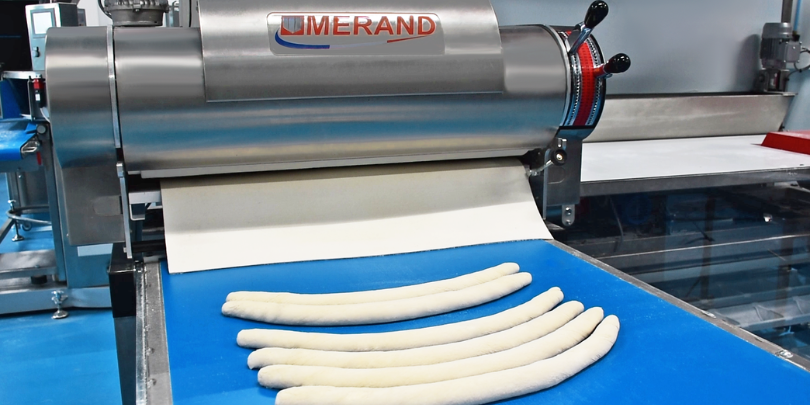
The gesture that programs the bread
The dough piece is proofed, extensible, ready. Everything before—mixing, dividing, pre-shaping, proofing—had only one purpose: to enable this gesture. Shaping adds no matter, adds no time. It reorganizes. In seconds, it decides the shape, future volume, crumb structure, and where the bread will open in the oven. It is the fastest stage of baking, and it is irreversible.
All of shaping comes down to two inseparable moments:
- Create a skin: stretch and orient the external layer of the network into a taut, smooth, continuous film.
- Lock it: solder this tension so it holds until the oven. A skin that is not locked relaxes; a lock without skin holds nothing. The seven mechanisms that follow serve only this pair.
1 – ORIENT: From Relaxed Disorder to Aligned Fiber
At the end of proofing, the network is loose and disordered: relaxation has erased tension, but also orientation. Shaping re-aligns. Under stretching and wrapping, glutenin chains pass from coiled state back to fibrillar state in a directional and permanent way, along the axis of the product.
Here the first distinction between round, baguette, and batard appears. For a baguette, orientation is axial: you stretch and wrap in one direction, the fibers align along the dough piece. This orientation allows elongation without rupture and gives the crumb its regular grain. For a round or batard, orientation is multidirectional: you tension the surface in all directions around a center, creating a membrane that encloses the dough piece everywhere.
And a material science phenomenon comes into play: work-hardening. A gluten network stretched repeatedly hardens and strengthens under deformation (like metal worked cold). Shaping therefore does more than orient: it stiffens the surface through the mechanical work itself. Hence the rule: shaping too aggressively overstretches the skin and makes it brittle; shaping too gently does not structure it.
COILED STATE → (DIRECTIONAL STRETCHING) → ORIENTED FIBRILLAR STATE + WORK-HARDENING
2 – TENSION: The Skin Gradient, Signature of Shaping
This is the heart of the matter. Shaping creates a gradient of structure between surface and core, and this gradient is the bread.
On the surface, the network undergoes biaxial traction: it is stretched in two directions simultaneously, which flattens and orients the alveoli, expels large gas, and forms a dense, smooth, continuous gluten film—the skin. At the core, nothing of the sort: the alveoli remain preserved, the network retains its gas. A well-shaped dough piece is therefore two materials in one: a taut, gas-impermeable envelope, and an aerated, supple interior.
This gradient commands the entire future of the bread. The skin will retain the gas produced during final proof; without it, CO₂ escapes and the dough piece collapses. It will determine the grigne (the bread's ear): the blade will open where surface tension is maximum, and the bread will develop in the direction the skin allows. Shaping is literally programming the proof and opening of a bread that will only bake later.
Nuance: on a baguette, the skin is tensioned mainly along the axis → longitudinal development, sharp ear on an angle. On a round, the skin is tensioned evenly → spherical proof, ear in a cross or crown. The geometry of tension draws the geometry of the bread.
BIAXIAL TRACTION ON SURFACE → DENSE FILM (SKIN) · PRESERVED ALVEOLAR CORE → GRADIENT
3 – LOCK: The Bonds That Freeze Tension
Creating the skin is not enough: without a lock, elasticity would make it relax. Shaping freezes tension by two molecular pathways.
First, hydrogen bonds: under stretching, chains drawn together on the surface form a multitude of weak bonds that, through their number, stabilize the new geometry. Reversible individually, they hold collectively.
And then—the deep mechanism—thiol/disulfide exchange. Under mechanical stress, existing disulfide bonds (–S–S–) break and reform in the stretched configuration, through exchange reaction with free thiol groups (–SH). Concretely, the network does not just stretch: it re-welds in its new shape. This is the exact counterpart of what happens during mixing, but applied locally to the skin and final geometry. It is this covalent rearrangement that makes skin tension durable. It is not merely maintained, it is chemically inscribed.
–S–S– + –SH (STRESS) → THIOL/DISULFIDE EXCHANGE → NETWORK RE-WELDED IN STRETCHED GEOMETRY
And the ultimate lock, mechanical: the seam. The wrapped dough piece must close on itself in a sealed joint. Sealing is reconnecting the network: the two faces of dough must fuse into a continuity of gluten. Two imperative physical conditions: dough seals only to itself (not to flour: excess dusting at the seam prevents contact and the joint will open), and only if it is still slightly moist and extensible (a crusted surface does not fuse). A poorly sealed seam is an interrupted network: in the oven, gas forces the weak point and the bread opens anywhere. A well-sealed seam, by contrast, orients the opening toward the intended grigne.
4 – DOSE THE GAS: Selective Degassing and Laplace's Law
Shaping is degassing, but degassing is not emptying, it is sorting. Shaping must expel large gas (irregular large bubbles from uneven fermentation) while preserving the fine nuclei that will give a regular, alveolar crumb.
The physics is governed by Laplace's law: the pressure difference inside a bubble is inversely proportional to its radius (ΔP = 2γ/r). In other words, small bubbles are under higher pressure than large ones and tend spontaneously to empty into them. A phenomenon that, left to its own devices, would create large holes. Shaping reverses this tendency: by pressing and reorienting, it fragments the large pockets and redistributes gas into a multitude of finer, more stable nuclei. This is what calibrates the crumb.
Hence the dosing, and the product nuance: sandwich bread or tight white baguette demands aggressive degassing → fine, regular crumb. Ciabatta, very open French traditional → minimal degassing, you preserve large alveoli → open crumb. The same gesture, two intensities, two breads. The baker decides not only the shape at shaping: he decides the alveolar caliber.
LAPLACE: ΔP = 2γ/r · LARGE GAS EXPELLED + FINE NUCLEI REDISTRIBUTED → CRUMB CALIBER
5 – THE MEMORY THAT REPLAYS: The Verdict of Proofing
Shaping is the final judge of proofing. All the elastic memory you sought to erase during rest replays here, at the moment of stretching.
If proofing was sufficient, the network is extensible: it accepts stretching, allows itself to be oriented, takes on skin without resisting. If it was too short, elastic memory is intact: the dough piece resists, shrinks back as soon as you release it (the baguette shortens on the bench or leaving the shaper), and tears when you force it. The skin ruptures instead of tensioning. If proofing was too long, the network has no strength left: the skin cannot hold tension, the soft dough piece spreads, the seam does not fuse. Shaping never corrects a failed proofing, it punishes it.
This is why these two acts are inseparable: you only shape well what you have proofed well.
6 – SURFACE MOISTURE: The Hidden Condition of the Skin
One parameter silently decides success: the hydration state of the surface. Skin is created by stretching a gluten film, yet a film is extensible only if sufficiently hydrated.
- Too dry a surface (dough piece crusted by too-long or over-ventilated proofing) has lost its surface extensibility: under stretching, it tears instead of tensioning, the skin cracks, the grigne will be chaotic.
- Too moist a surface (over-hydrated dough whose water has wept, insufficient dusting) sticks, does not slip under wrapping. Between the two, the window: a surface supple, slightly film-forming, dry to the touch but extensible. This is exactly what well-conducted proofing with a good breathable support—neither wet nor drying—has prepared: the direct link to the role of Nyltex® seen in the previous dossier.
TOO DRY SURFACE → TEARS · TOO MOIST → STICKS, DOES NOT SEAL · SUPPLE & EXTENSIBLE → CLEAN SKIN
7 – DIAGNOSIS: A Well-Shaped Dough Piece
- Smooth, taut skin: satin surface, no tears or blisters, which resists slightly to finger pressure.
- Regular, oriented shape: homogeneous section along the entire length—baguette, batard, or round—without constriction or soft spots.
- Seam closed and nearly invisible: Beautiful joint, placed white (seam beneath) or grey (seam above), that does not gape. Guarantor of controlled opening in the oven.
- Structure: the dough piece holds its shape when placed, does not collapse.
- The fault that speaks: skin that tears = too dry or over-shaped; dough piece that shrinks back = under-proofed; seam that opens = sealed over flour or surface too dry.
THE GESTURE DECOMPOSED
The three stages of shaping
A common grammar — baguette, batard, round
Whatever the target shape, shaping is done in three movements, always in the same order, because physics demands it. What changes from one bread to another is not the grammar, it is the geometry you give it.
1 · LAMINATION
Degas and prepare the surface
The proofed dough piece is gently flattened with light tapping or regular lamination. This is where selective degassing occurs (large gas expelled, fine nuclei redistributed: the crumb caliber is decided here), thickness is made uniform for what follows, and the skin is initiated by a first stretching in the plane. This is the most aggressive step for alveolar structure: you choose the lamination height based on the crumb openness you want in the final product.
2 · STRUCTURING
Create the skin/core gradient
You close the dough piece back on itself. This is the gesture that creates the skin (stretched, continuous surface) and traps the alveolar core. It takes two forms depending on the product:
- Baguette → axial wrapping: the spirals tighten against each other, the skin tensions longitudinally, the final spiral seals the seam;
- Round → folding toward the center: the edges fold in from all sides, the skin envelops the dough piece, the folds converge in a seam below.
- Batard → by combining both: folding + wrapping
This is where the direction of tension is decided: axial for length, radial for roundness.
3 · FINAL TENSIONING
Tension and lock the skin
You complete by stretching the skin to its final tension:
- Baguette and batard → elongation: progressive axial traction that brings it to length, equalizes tension, and tapers the ends.
- Round → rotational rounding: rotation tensions the skin evenly biaxially and seals the seam below in a single movement.
LAMINATION (DEGAS + INITIATE) → STRUCTURING (WRAP / FOLD) → FINAL TENSIONING (ELONGATE / ROUND)
The same grammar, three geometries. Baguette, batard, and round do not differ by the gestures but by the intensity and direction you give them: you always laminate, always structure, always tension. The baguette tensions along the axis, the round in all directions, the batard is the intermediate. A short wrap, a moderate elongation, skin deliberately less tight. The order, however, never changes: you only tension what you have structured, you only structure what you have laminated.
✦
"Shaping is building a skin and locking it. Everything else—orienting, degassing, sealing—exists only for this. Tomorrow's bread is decided in seconds, today."
SHAPING PRINCIPLE · CREATE A SKIN, THEN LOCK IT
|
Mechanism |
Physicochemical Effect |
Consequence on the Bread |
|---|---|---|
|
Orientation |
Coil → fibrillar + work-hardening |
Aligned network, stiffened surface |
|
Skin tension |
Biaxial traction on surface |
Skin/core gradient, gas retained |
|
H-bonds + thiol/disulfide |
Tension frozen chemically |
Durable skin, does not relax |
|
Sealing (seam) |
Network reconnected in continuity |
Controlled opening in oven |
|
Selective degassing (Laplace) |
Large gas expelled, fine nuclei redistributed |
Crumb caliber set |
|
Elastic memory |
Verdict of proofing |
Shapeable or shrunk/torn |
|
Surface moisture |
Extensibility of gluten film |
Clean skin, seam sealed |
TECHNICAL APPLICATION
MERAND Shaping Machines
Mechanical shaping is reproducing faithfully the three stages: laminate, wrap, elongate. Without betraying the dough. Since 1954 and the first shaper, this is the heart of our business. And the first rule applies to all our machines: laminate with precision. Our Alvéo+® roller, covered with alveoli (like a golf ball), reproduces manual lamination. Without crushing the alveolar structure, even on fragile doughs; the PPR® automatically adjusts the roller to the dough piece height and allows creating a beautiful skin. Who would imagine reducing a 5cm-thick dough to 1cm in a single pass? The dough piece emerges healthy; what remains is to structure and tension it. Two schools for this: vertical and horizontal.
THE CHOICE OF NATURAL WOOL FELT: The Material in Contact with the Dough
Before even discussing vertical or horizontal, a choice sets us apart: on our shapers, we have chosen natural wool felt in contact with the dough, while many have switched to synthetic. It is not a matter of tradition, it is a matter of contact physics.
Shaping demands three contradictory qualities of the belt, and natural wool is one of the rare materials that reconciles them. Just the right grip first: for wrapping and elongating, the dough piece must catch enough to roll on itself, without sticking to the point of tearing. Wool fiber, naturally scaled, offers this living adhesion that drives the dough without tearing it.
Humidity regulation—and this is essential. As we saw, skin is created well only in a precise window: supple, dry to the touch, yet extensible. Wool is hygroscopic: it absorbs excess surface water from a dough piece that is too moist (it prevents sticking) without drying out the skin. It buffers the dough piece's hydration state at the exact moment it tensions. An inert synthetic belt, by contrast, does not breathe: water stagnates on the surface, dough sticks, skin tears.
Gentle contact finally: supple and warm, the felt hugs the dough piece, accompanies rolling, and does not mark the skin just created, unlike a hard or too-rough surface that shears or slips.
When synthetic is required: our inverted diamond-point belt. Certain markets and certain standards (hygiene, cleanability, regulatory constraints) demand a synthetic coating. Rather than accepting its drawbacks, we have rethought it: our synthetic belt is molded with inverted diamond points, a geometry that reduces the contact surface between the belt and dough to the bare minimum. The dough piece is driven by the ridges, enough for good wrapping, while touching as little material as possible, which limits sticking and preserves the skin. The result on elongation approaches that of wool felt: not quite at its level, but very good quality when the standard demands it. Where a flat synthetic would have stuck and torn. An engineering answer to a regulatory constraint, without surrendering respect for the dough.
In contact with the skin just tensioned, we have chosen the natural fiber that the baker's hand has always preferred: wool. And where regulations demand synthetic, we have made one that approaches it.
THE VERTICAL SHAPER: Compact and Versatile
In a vertical shaper, the laminated dough piece is wrapped then elongated in a short vertical path: the wrapping is 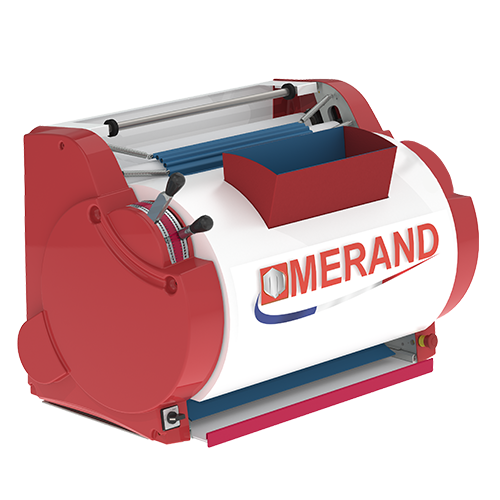 done against a heavy, adjustable-weight belt, and elongation is achieved rapidly by two belts rotating in opposite directions. The advantage is mechanical and economic: small footprint, great simplicity, maximum versatility thanks to numerous accessories. This is the shaper for the bakery that wants to do everything well. Its limitation lies in elongation: on a short, fast path, elongating demands more pressure over less distance. Perfect for standard lengths, but limited on very long baguettes and the most fragile doughs.
The vertical range: the Trégor®: our best-selling shaper ever, economical, reliable, versatile; the Trégor® PPR® (progressive adjustable pre-lamination); the Trégor® Tradition (in addition to PPR®, patented Alvéo+® and Pointop® systems, automatic pointed ends).
THE HORIZONTAL SHAPER: The Baker's Gesture Reproduced
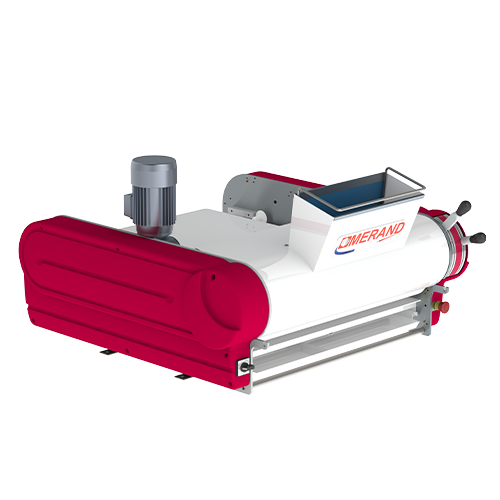
In a horizontal shaper, elongation is done on a fixed table: a pressure belt rolls the dough piece along the table, exactly as the hand rolls it on the work surface. Elongation is no longer compression over a few centimeters, but progressive rolling over a real distance, in 2 stages, with slight relaxation between them. This allows elongating longer, slower/more progressively, without forcing, to the desired length without manual finishing. And because we no longer compress to stretch, the dough does not heat up: no excessive friction, no temperature rise that would soften the network.
The horizontal range: the Armor® (elongation in 2 stages, with optional features: Alvéo+®, Pointop®); the Armor® HV (High Volumes), reinforced for sustained throughput; the 3Form, with progressive shaping in 3 stages; the Proform is our largest shaper with C2A® (Assisted Elongation Control) and touchscreen, up to 2,500 baguettes/hour.
WHY THE HORIZONTAL IS TECHNICALLY SUPERIOR: Elongation, the Critical Point of Shaping
Everything hinges on elongation—the most delicate of the three stages. We have established it: overly strong or fast elongation cracks the skin; jerky movements create constrictions; one must elongate progressively, letting the network follow. This is precisely what horizontal geometry allows and what vertical cannot offer to the same degree.
Tout se joue sur l’allonge le plus délicat des trois temps. On l'a établi : une allonge trop forte ou trop rapide fissure la peau ; par à-coups, elle crée des étranglements ; il faut allonger progressivement, en laissant le réseau suivre. C'est précisément ce que la géométrie horizontale permet et que la verticale ne peut offrir au même degré.
On the fixed table, elongation is long, progressive, and without heating: it reproduces the manual gesture that the entire craft recognizes as the reference. It respects the skin instead of forcing it, preserves the alveolar structure of fragile and highly hydrated doughs, and achieves lengths that vertical cannot sustain without constraining the dough. For traditional baguettes, long baguettes, and delicate doughs, horizontal is therefore the technically superior solution—not because it is more complex, but because its elongation is faithful to the physics of the gesture.
This does not disqualify vertical: for routine, versatile production on limited footprint, it remains excellent and unbeatable on the ratio of footprint/versatility/price. But as soon as elongation becomes the critical point—length, fragility, tradition—horizontal gains the advantage.
THE DIFFERENCES IN THE RANGE: Elongation Length and Wrapping Quality
Within the horizontal line, models distinguish themselves on the two parameters that make quality long-dough shaping. Elongation length first, dictated by table length and number of stages: the longer the table and the more fractionated the elongation, the longer baguettes you produce without forcing. This is the progression Armor (2 stages) → 3Form (3 stages) → Proform (assisted and controlled elongation): at each step, elongation becomes longer and more progressive, therefore more respectful.
Wrapping quality next: regular, well-tight wrapping fed by controlled lamination that hasn't over-degassed produces homogeneous skin and regular crumb along the entire length. The patented systems (Alvéo+®, PPR®) all aim at the same goal: laminate and wrap without over-degassing or tearing, with increasing fine-tuning as you move up the range and throughput.
The choice reads simply: vertical for compact versatility; horizontal for elongation quality; and within horizontal, you move up in table length and number of stages as baguettes get longer and throughput climbs.
AND FOR THE ROUND: The RotaBall®
The tensioning of a round does not elongate, it rotates. Our eccentric rounder RotaBall® reproduces the baker's gesture: its dome tensions the skin in rotation, with adjustable compression force, for great respect of alveolar structure even on highly hydrated doughs, from bun to large round (75g to 4kg). Its bypass lets dough pieces that should not be rounded (baguettes) flow directly to the shaper: you tension only what needs tensioning.
Vertical does much on little space. Horizontal does long without ever jarring the dough. Both laminate, structure, and tension, but it is on elongation that the art of shaping is measured
✦
« Our machines are designed by bakers, for bakers. »
Come meet us!
We welcome you to our BakingLab® to test our machines. Bring your flour, bring your questions, we'll provide the rest.
Next episode:
Final Proof & Scoring:
The last proof, and the last gesture before the oven